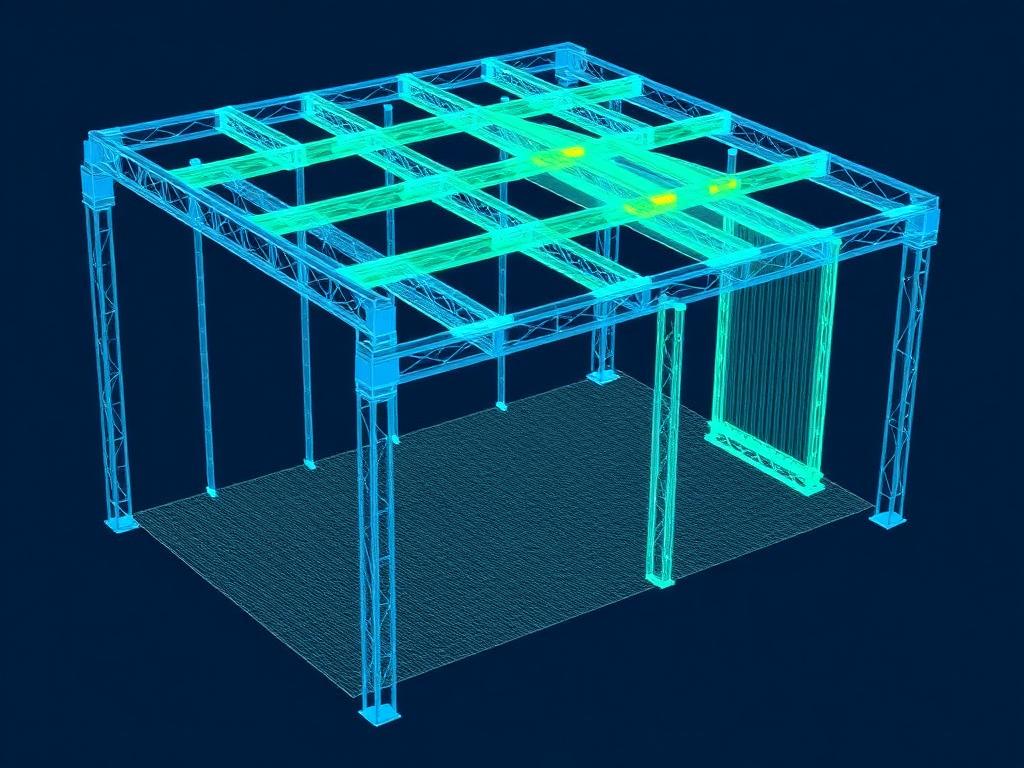
Structural Integrity Analysis
Understand the structure before it becomes a problem.
Code compliance, linear and non-linear FEA, seismic analysis, vibration, dynamics, post-buckling, fracture mechanics and fatigue — a complete structural integrity capability.
Deliverables
What we deliver
Every capability below is delivered by senior engineers — documented, verified and defensible.
Code Compliance Assessment
Systematic verification of structures against applicable codes and standards.
Linear Finite Element Analysis
Efficient FEA for structures operating within linear-elastic behaviour.
Non-Linear Finite Element Analysis
Material and geometric non-linearity for structures pushed beyond linear assumptions.
Seismic Analysis
Response spectrum, time-history and pushover approaches for seismic performance.
Noise & Vibration Assessment
Evaluation of vibration sources, transmission paths and acceptance criteria.
Structural Dynamics
Modal and dynamic response analysis for equipment, structures and foundations.
Post-Buckling Response
Assessment of stability and post-buckling behaviour in slender structures.
Fracture Mechanics
Crack-growth and fracture assessment supporting fitness-for-service decisions.
Fatigue
Fatigue life evaluation for cyclic loading in structures and equipment.
Field Measurement
Stress, strain, pressure and temperature measurement to anchor models in reality.
In the field
Typical use cases
- Fitness-for-service evaluation of ageing structures
- Seismic qualification of industrial facilities
- Vibration assessment for rotating equipment foundations
- Fatigue evaluation of cyclically loaded components
Start the conversation
Every engagement starts with a scoping call with a senior engineer — no obligation, no sales script.
Answers
Common questions
When does a structure need a formal integrity analysis?
When loading changes, damage is found, codes are updated, or the asset approaches the end of its design life — or whenever the consequence of failure justifies the analysis.
What is the difference between linear and non-linear FEA?
Linear FEA assumes materials stay elastic and deformations are small. Non-linear FEA captures yielding, contact, large deformation and buckling — behaviour that linear models cannot represent.